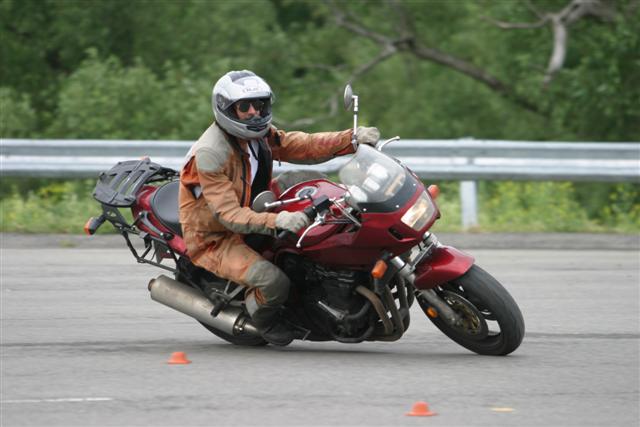
Emergency Braking for Motorcyclists
Very little causes more confusion in my beginner motorcycle classes than the subject of braking. Topics we frequently discuss:- Which brake should you use?
- Won't overuse of the front brake make you go over the handlebars?
- Should you use engine braking?
- Why do motorcycle designers make the front brake so powerful, rather than balancing the braking power?
- How do I "lay it down" in an emergency?
- If the emergency happens in a curve, what then?
Weight shift and the effect on traction
Let's try an experiment. Picture a motorcycle tire on the pavement. Not the wheel, not the entire bike, just the tire standing upright. Take hold of it and try to slide it across the pavement. It slides pretty easily. Now ask your assistant to stand on the tire, and then try to slide it. Much harder to slide, right? In other words, the tire has a lot more traction now. If you add the weight of two or three people, it gets harder yet.So what we've seen is that there's a relationship between weight and traction, and it is this: More weight, more traction.
A motorcycle in operation has a certain weight distribution, as designed by its makers. Suppose now some BDC (BDC is a technical term used by motorcyclists; it stands for "brain-dead cager") jumps out in front of that bike and rider, and the rider gets on the brakes. What happens to the weight of the bike? It shifts forward, toward the front tire. And in keeping with our earlier discovery of the relationship between weight and traction, the traction at the front tire increases and that at the rear decreases. So the result is that the rider can now use more front brake than he could an instant before, before the weight had transferred. If he does use more front brake, then still more weight shifts forward, raising the traction at the front still more, which enables still more front brake to be used.
Now you can see why the front brake is so much more powerful than the rear, why my Bandit has two large disks on the front and a single small disk on the rear. It's simply a response to the fact that matter has inertia, that is, that when you try to stop something, weight shifts forward.
Why use both brakes?
Ok, so the front brake is more powerful than the rear due to laws of physics. How much more? The Motorcycle Safety Foundation's student class materials say that about 70% of a motorcycle's braking power is at the front brake. I think that's a gross underestimate. Have you ever seen a sportbike stopping so fast that the rear tire is in the air (a "stoppie")? How much of that motorcycle's braking power is in the front? Right, 100%.Now that's not a reason to ignore the rear brake for several reasons. In the first place, only a short and light motorcycle will loft the rear tire; a cruiser, for instance, is too heavy and too long to do that. The rear tire will always be on the ground with some weight, and hence some traction, on it. Furthermore, even on a short light sportbike, it takes significant skill to do it. Contrary to what a lot of my students think, just grabbing the front brake will not cause the rear tire to rise; it'll cause the front tire to skid and dump you.
Still, though, the front brake has far more power than the rear, so why use the rear at all? That's pretty simple: In an emergency, are you going to be satisfied with 70%, or even 95%, of your braking power? Not a chance. If both tires are on the pavement then they both have some traction. In an emergency, use it all.
Ok, I will, in an emergency. How about that routine stop at the traffic light? I don't need 100% of my braking power there; maybe more like 5%. Do I need to use both brakes there?
Yes, you do. It's a matter of habit, of being prepared for the emergency. If you routinely use just one brake, when the BDC stops in front of you, what are you going to do? You're going to do what you always do, that's what. So I insist that my students always make flawless stops: Both brakes. Right foot stays on the brake all the way to a stop, with no paddling at the end. Be in first gear by the time you stop. Do it right every time, so you'll do it right when it counts.
Shifting too?
Yes, shifting during the stop too. What are you going to do if that person behind you can't stop as quickly as you can? Or if he isn't paying as much attention to his driving as you are? Now you have another emergency, and this one requires you to get out quickly. No problem — IF you're in first gear. So BE in first gear. Do not be caught dead in second gear. Shift to first gear during the stop, every stop.How many times to downshift? 13 should be enough. Seriously, if you think you're in third gear, don't be satisfied with two downshifts. You might have lost track and be in fourth gear. You might not hit the shifter hard enough and go to neutral. Keep shifting down until you know you're in first gear (because it didn't shift again at that last press), and then shift down twice more. Do not be caught dead in second gear.
I'll just use engine braking so I'll stop even faster!
Everyone knows that just getting off the throttle will cause you to slow down. Anyone who's driven a vehicle with a manual transmission knows you can get a greater effect by downshifting first. But I didn't say anything about it in my emergency braking discussion because it isn't effective. Consider that engine braking works on the rear wheel. If you want more braking from the rear wheel, then just press on the rear brake pedal a little more. That's simpler, smoother, and more precise than pausing in your shifting to first gear (because you aren't going to be caught dead in second) and releasing the clutch. And simple, smooth, and precise are things you want in motorcycling.I'm not going to tell you I never use engine braking. If I need to downshift for a turn, it may be true that just easing out the clutch will give me all the braking I need for the turn. But in general, I use the brakes for braking, and I use the engine to go.
Emergency Stop!
So let's put all this together. How do you stop in the shortest possible distance? You use both brakes. You use progressively increasing pressure on the front brake, to use the increasing traction at the front as the weight shifts forward. You use light pressure on the rear brake; there isn't much traction back there because so much of the weight has shifted forward, but there's some, so use it. You squeeze the clutch and you tap on the shifter, without counting the taps, until your left foot has to go down just before you stop.And how does this differ from a routine stop? Only in the amount of pressure used on the brakes. Everything else is the same, must be the same, because you want it to be automatic in an emergency. The only way to make it happen automatically is to do it the same way every time.
In the ultimate emergency, I'll just lay it down.
You mean you'll crash? Why? Wouldn't you rather avoid crashing? Do you think motorcycles stop faster on their sides than on their tires? This makes no sense. Tires have better traction than plastic and chrome. Keep the motorcycle upright and use the brakes, or swerve around the problem.What about braking in a curve?
The problem with braking in a curve is that some of your traction is being used in turning the motorcycle. That part of the traction hasn't disappeared, but it's unavailable to you for braking. One option is to brake, but more gently than you could if the motorcycle were straight. This is what you'd do on a curving off-ramp with a stop sign at the end. Just use the brakes gently to come to a perfectly routine stop at the end of the ramp.The problem comes when you need to brake hard while you're turning; maybe there's a dead deer in the middle of the road part way through the turn, and when you see it you're leaned over, going fast, and using up much of your traction keeping the motorcycle turning. Your best option might be to get the motorcycle upright as quickly as possible, which will make that turning traction available to you again, and then use it in a maximum straight-line stop.
By the way, if you can't get stopped before you hit the dead deer, then you made another mistake before you entered the turn: You entered too fast. If you can't stop in the distance you can see, you should seriously consider slowing down until you can.
Swerving and braking
The discussion on braking in curves applies to swerving also. A swerve is just a hard turn to avoid something, like a shovel that fell out of the truck in front of you, followed by another hard turn to straighten up again. In those two hard turns, your traction may be used to the limit; don't ask for yet more traction from the tires by braking also. Brake first, then get off the brakes before you swerve; or swerve, and then get on the brakes after you're straight.Hard Data
The folks at Fédération motocycliste du Québec ran a series of tests on braking technique, investigating things such as whether to use both brakes, when to clutch, whether to downshift. You can read their report (in English, and thanks very much to the Francophones for translating) here. As far as I can tell the tests were well-designed and well-run, and give some real-world substance to the recommendations of the MSF and others. Here's what I think might be the most important conclusion of the series:"In our opinion, the only way for a rider to achieve true proficiency in straight-line emergency braking of a motorcycle is to practise long enough and hard enough to make the procedure a matter of habit."
Can you brake faster than cars?
Good question. During our emergency braking exercises I always ask this question, and I get two answers, both wrong. One is "Certainly not; motorcycle tires have two small contact patches, car tires have four larger contact patches, so motorcycles have less traction." You can read my page on traction and contact patch area to see why contact patch area is irrelevant, so this answer is wrong. The other answer is "Certainly; you can accelerate faster than cars because you're lighter. You can decelerate faster than cars, because you're lighter." I subscribed to the second view until one of my students, Eli Baldwin, said that the physics in the two situations is entirely different. He's right. Motorcycles can accelerate faster than (most) cars because the ratio of power to weight is greater for motorcycles; there may be less horsepower but it's pushing a lot less weight. But for braking, the horsepower of the engine is irrelevant. To find out whether motorcycles brake better than cars we have to look deeper into the physics of braking.
The force on a vehicle during a stop is just the vehicle's mass times the
(negative) acceleration, F = ma. That force has to be applied at the tires
via their traction. The friction
equation is F = μW (where W is the weight of the
vehicle and μ is the Greek
letter mu, the coefficient of friction — again see
laws of friction for details). The weight of the vehicle is the mass m times
the gravitational force g, so F = μmg. The maximum stopping force that
can be applied is the maximum frictional force that the tires can sustain, so
ma = μmg; and we can cancel the mass which appears on both sides to get the
maximum deceleration possible:
a = μg
Now before we go further, let's note some assumptions. One is that the downwards force in the friction equation is actually the weight of the vehicle. Race cars use airfoils to develop a downward force to improve their traction, so their stopping distances would be better than an unassisted vehicle (at speeds allowing the airfoil to work). If street cars ever begin to use this technology then the conclusions would have to change to take that into account.
Another assumption is that the limiting factor in stopping is traction, rather than the ability of the brakes to dissipate the energy. This is true of cars and motorcycles at normal speeds, as their brakes can overwhelm the traction of the tires, causing a slide. But it isn't true of large trucks. Their additional mass provides additional traction, as shown in F = μmg, but the additional energy is more than the brakes can deal with, resulting in longer stopping distances. And a reader, Garrett Underwood, pointed out to me that as speeds increase, even cars and motorcycles may become limited by the ability of the brakes to deal with the energy (which increases as the square of the speed). If this point is reached then motorcycles may have an advantage in stopping distance, as motorcycles generally weigh a quarter or less of a car's weight, so the kinetic energy which must be converted to heat is also a quarter or less. I don't know where the tipping point is between tire traction and braking energy as the limiting factor, but as Garrett mentioned, the difference in stopping distances between smaller passenger cars and larger SUVs and pickup trucks widens dramatically from 60mph to 80mph, suggesting that energy becomes a factor even at those speeds.
Brake design plays a role. Drum brakes don't deal with energy as well as modern disk brakes. Two large brake disks on a sportbike will move more energy than a single small disk on a cruiser. The same factors in auto brakes will affect which auto can outbrake which motorcycle.
The limiting factor in a stop of a motorcycle may also not be the traction, but the stability of the vehicle. We've all seen sportbikes with the rear tire in the air in a stop. The front tire isn't sliding, so there may be still more traction available to slow, but any additional braking will just result in the motorcycle going over the front tire.
But with the assumption that stopping distance is limited by the traction of the tires, a = μg shows that the mass of the vehicle is not relevant; it does not enter into the equation. The only difference might be in the value of μ for car and bike tires. I had speculated that motorcycle tires have stickier rubber than auto tires, because of the difference in tire life. Softer rubber being stickier than harder rubber, and having a shorter life, it might follow that motorcycle tires are stickier than auto tires. But a reader, Blane Baysinger, pointed me to a Society of Automotive Engineers article comparing motorcycle and auto tires. This article indicates that the coefficient of friction of both auto and motorcycle tires is about 1.2 on dry surfaces (declining to .7 to .9 when skidding). The difference in longevity appears to be due to the greater amount of rubber on the auto tires; and it appears that if you can stop faster than a car, it's because you're better at using the brakes, not because of any inherent superiority in the braking capability of a motorcycle.
And there is one final complication: Can you use all the traction of your motorcycle tires? If you get too hard on the brakes in your car, you slide, you let off the pedal to resume rolling, you get back on the brakes. When the same thing happens on your motorcycle, the slide generally results in a fall. Thus motorcyclists are reluctant to approach the limit of their braking, where the same isn't true of auto drivers.
So where does this leave us? Here's my rule: I figure the guy in front of me is able to outbrake me, so I leave enough room between us, and look well ahead of him, so that I won't hit him. And I figure I can outbrake the guy behind me, especially if he's too close or not paying attention, so I leave even more room in front (to reduce the probability that I'll have to brake hard), and keep a close eye on my mirrors, and stay in the proper gear so that after braking hard I can escape if needed.
What do you think about antilock brakes?
Quite a few of my students are confused about what exactly antilock brakes do. A comment I've heard several times is "If I want the brakes pumped, I'll do it myself." That's a serious misunderstanding of what antilock brakes do. In fact, you don't want the brakes pumped. You want them applied as hard as possible, just short of the point where the tires begin to slide. That's where you get the greatest deceleration. The problem is that we humans have a hard time keeping the brakes at that point. The front tire, where nearly all of the braking power is, will slide if we brake too hard, requiring instant and dramatic action (namely, release of the brake) to prevent a fall. Many times we fail to react quickly enough, and crash. Or, fearing a fall, we don't apply the brakes hard enough and thus sacrifice some of our stopping distance.Antilock brakes will not activate unless the rider makes the mistake of applying the brakes hard enough to lock a wheel. But if that happens, the machinery reacts more quickly than we can, releasing the pressure on the brakes to resume rolling and prevent a fall, followed more quickly than we can by reapplying the brakes to resume the stop.
The word from the experts at the motorcycle magazines, the people who do the 60-to-zero braking tests, is that under test conditions, they can outperform antilock brakes. That is, if their skills are already highly-developed, and if they have three or four tries to get tuned up, and if they know exactly when they're going to start braking, and if there are no traction surprises (like going over a sandy or painted patch of pavement), then they can outperform the machinery. But under real-world conditions, they say that antilock brakes win.
That's good enough endorsement for me. Furthermore, my guess is that over the next few years even test conditions won't be enough to outperform antilock brakes. Neither of my motorcycles has antilock brakes. My next motorcycle will have them.